Technical specifications
- Caliber
- Enicar AR 1147, automatic
- Functions
- Hours, minutes, seconds, day and date
- Jewels
- 24
- Frequency
- 18,000 vph (2.5 Hz)
- Movement size
- 11.75 ligne, 6.0 mm high
- Case
- 34.5 mm diameter, 39 mm lug to lug, 12.5 mm thick
- Case material
- Stainless steel
- Crystal
- Replacement, 31.8 mm, secured with Seiko S-314 UV adhesive
- Bracelet
- Snake skin patterned, five-link
- Year
- Early 1970s (approximate)
- Serial number
- Worn away, none legible
- Condition on arrival
- Non-running, no crystal, no seconds hand
- Serviced
- 5 November 2026
- Non-original parts
- Crystal and seconds hand replaced; day disc re-attached with adhesive
- Price paid
- 20 dollars
How it arrived
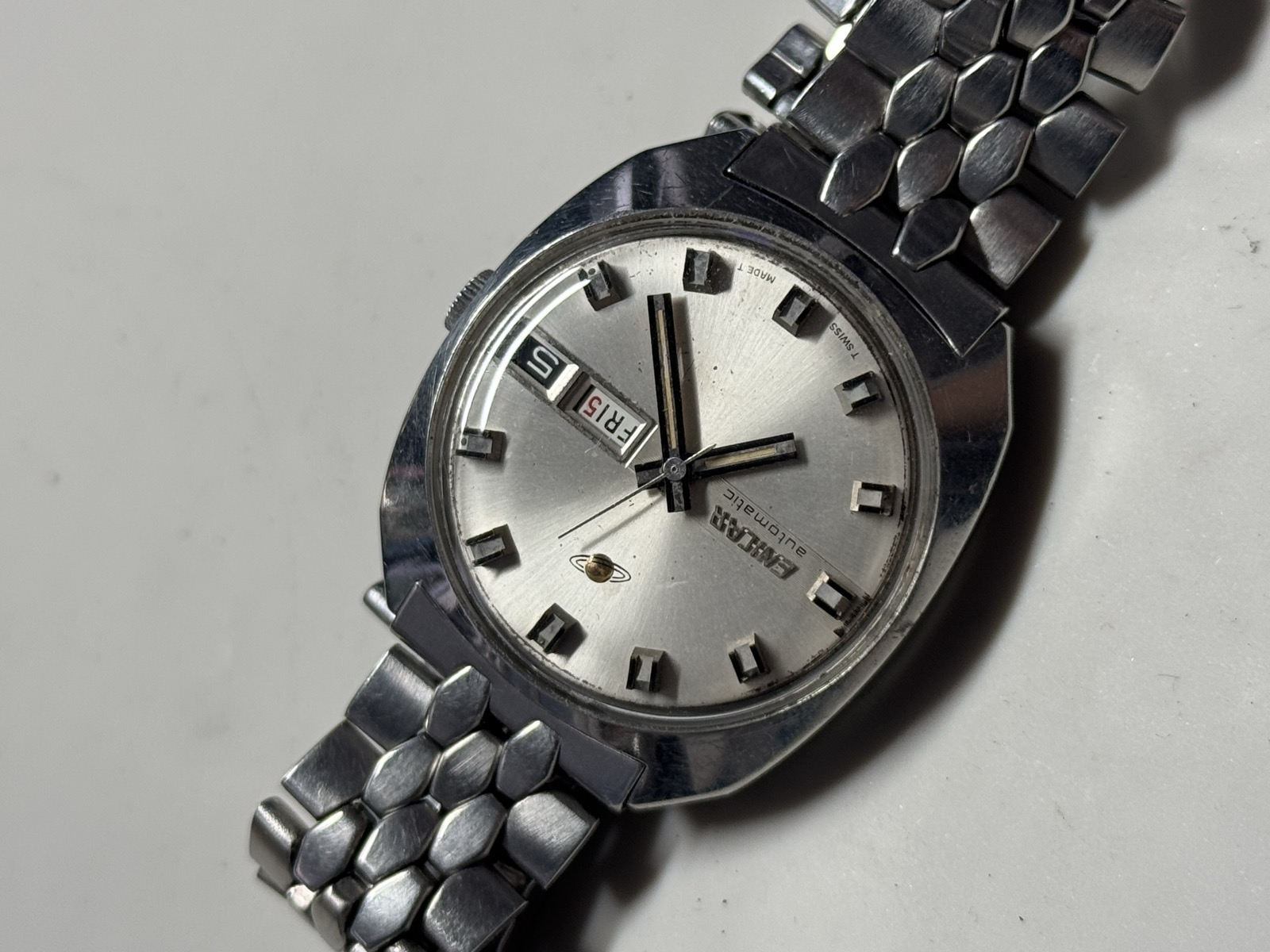
Today on the bench is an Enicar Ocean Pearl, approximately from the early 70s. I acquired the watch from a junk watch seller I have personally known for a while, for a whopping 20 dollars. No crystal, no seconds hand, and ultimately in non-running condition.
I inspected the watch briefly before acquiring it. The rotor was spinning, which is a good sign! However, there seemed to be no movement at all. Maybe a broken pivot? Maybe it just needs a service. I decided to take the gamble.
Design and build
The size. The watch measures 34.5 mm in diameter and 39 mm lug to lug. Including the replacement crystal, the thickness is 12.5 mm.
The indexes and logo. The applied indexes, with their recessed texture, are a prime example of an early 70s watch! The lume itself is still there, only the luminescence is gone, and it has developed a great-looking patina ( the T either side of "Swiss Made" at six marks it as tritium, which stops glowing a long time before it stops looking good ). The dial also features Enicar's iconic Saturn logo.
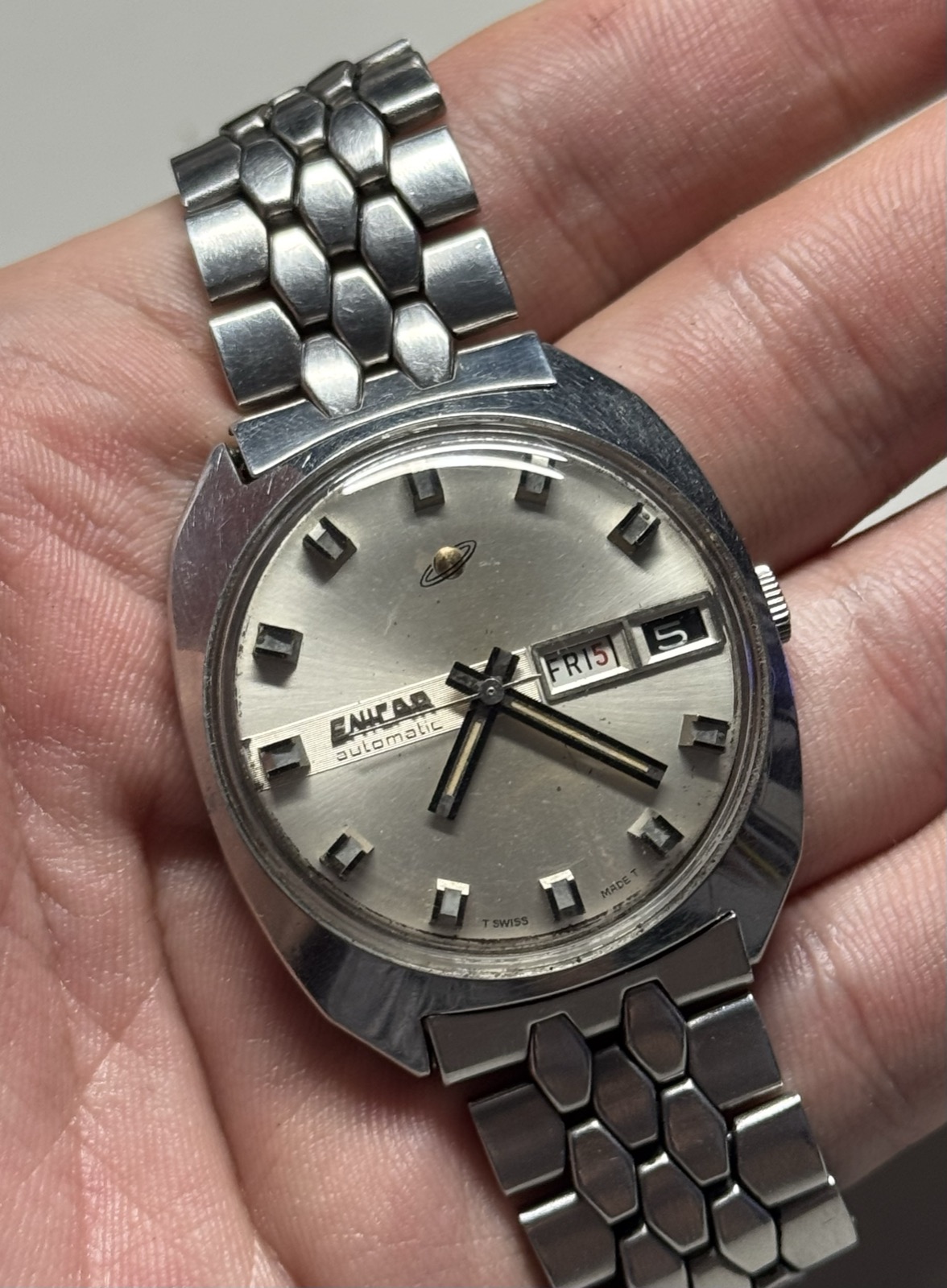
The bracelet. One of the main points of this watch is the bracelet. It's a snake skin patterned, 5-link bracelet, and it's well executed. It matches the rugged and elegant vibe of the watch.
The dial. The silver sunburst dial glows beautifully in the sunlight as well!
The movement
As I was unfamiliar with this movement, I did some research online. Here is what I found.
The AR 1147 belongs to Enicar's 114x family, a series of hand-winding and automatic movements produced in the mid-1960s. The whole family measures 11.75 ligne (about 26.4 mm) and beats at 18,000 vph (2.5 Hz) [2]. It was fully jeweled and featured Incabloc shock protection, which was modern for its time [1].
The AR 1147 is the automatic day-date version, with 24 jewels and a height of 6.0 mm [1]. The automatic versions reach that jewel count through extra jewels on the minute wheel and the automatic transmission wheel [1]. That explains the ruby studs I noticed during disassembly, and other collectors have noted the same detail [3].
The day-date mechanism uses a separate pawl for each function. The date engages at 20:00 and the day engages at 21:00, and both finish switching at midnight [1].
I believe this movement showcases what Enicar was capable of during its heyday!
Sources (collector wikis and forums, not Enicar documents):
Servicing log
This is the watch once the case was open and the dial and hands were off. Everything below happened over one afternoon.
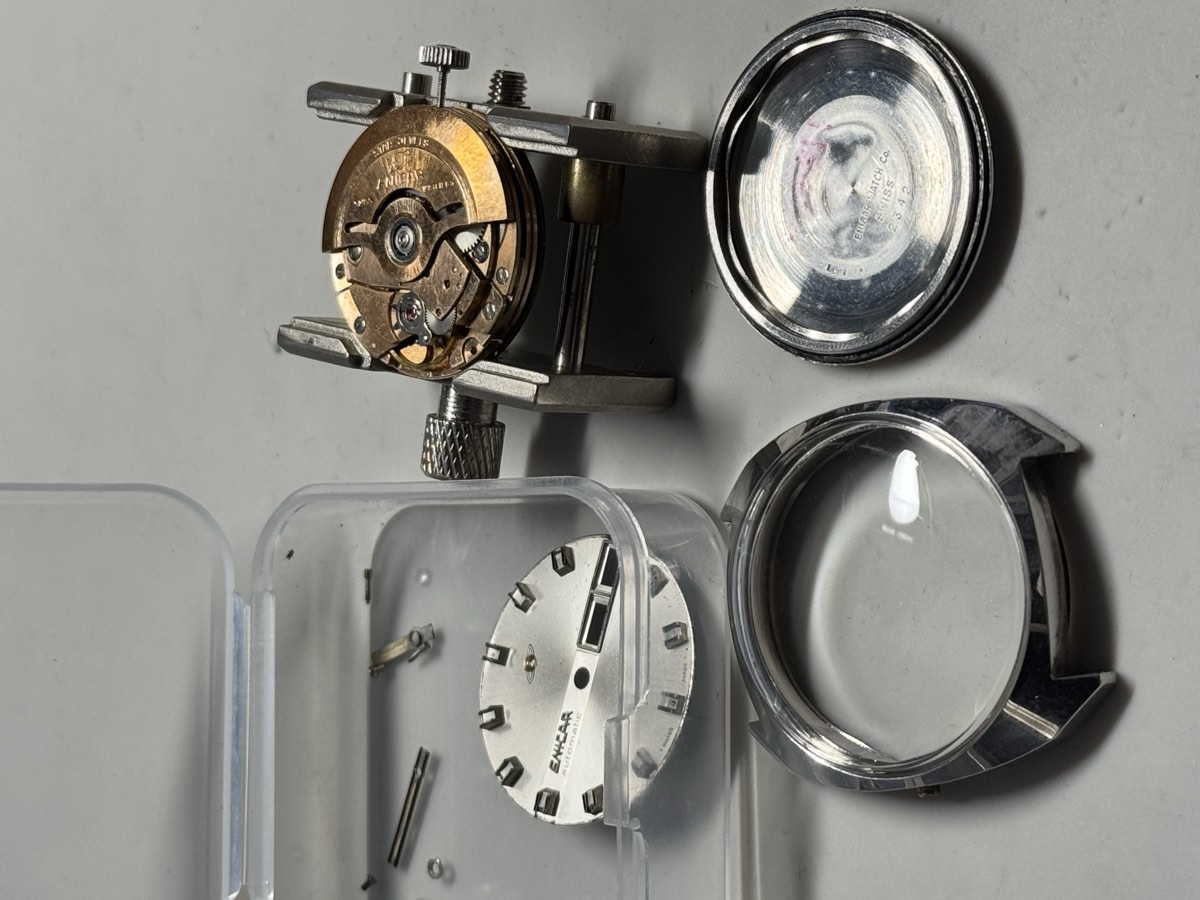
1. Rotor side, as opened
Surprisingly, the movement is in decent condition, without much rust nor oil stains. You can see the automatic module and the rotor.
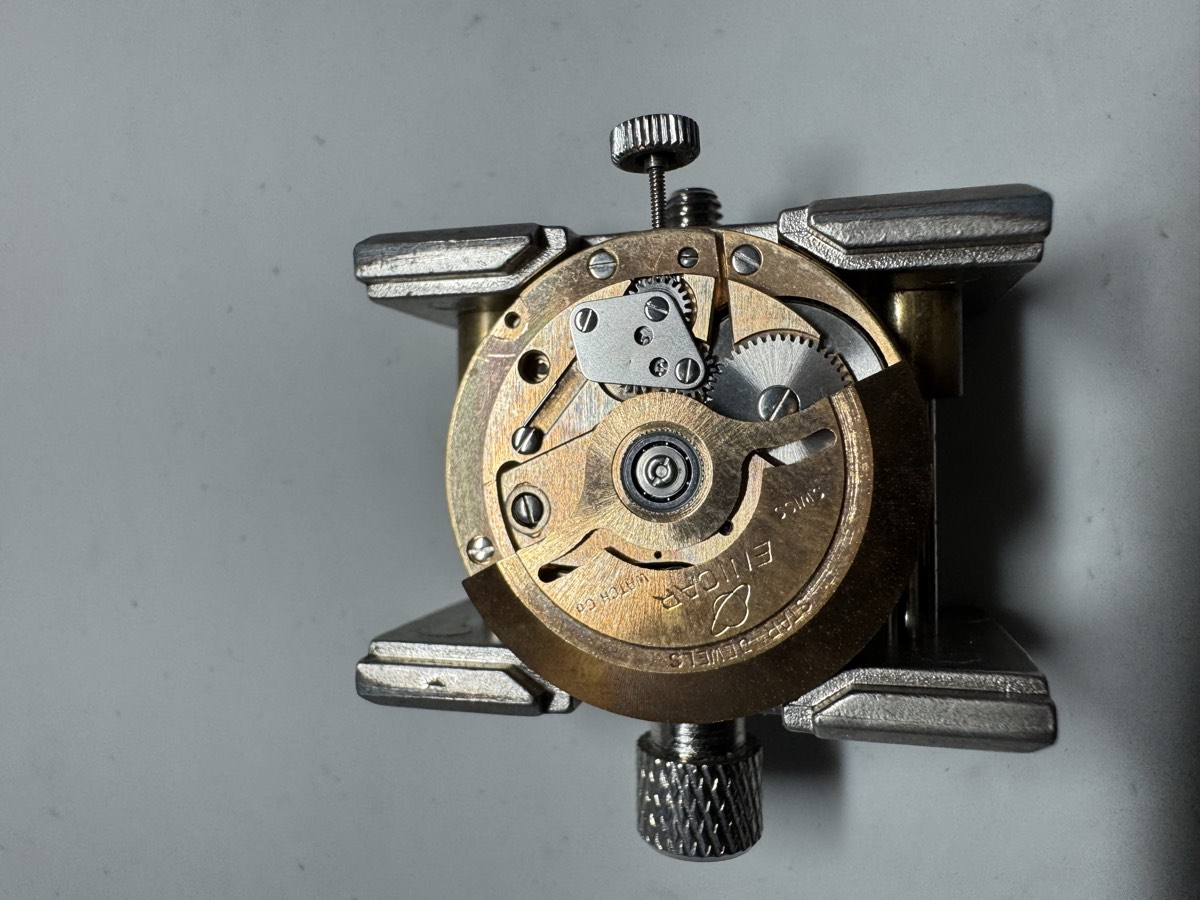
The rotor flipped to the other side. You can see the dormant balance wheel, not budging at all.
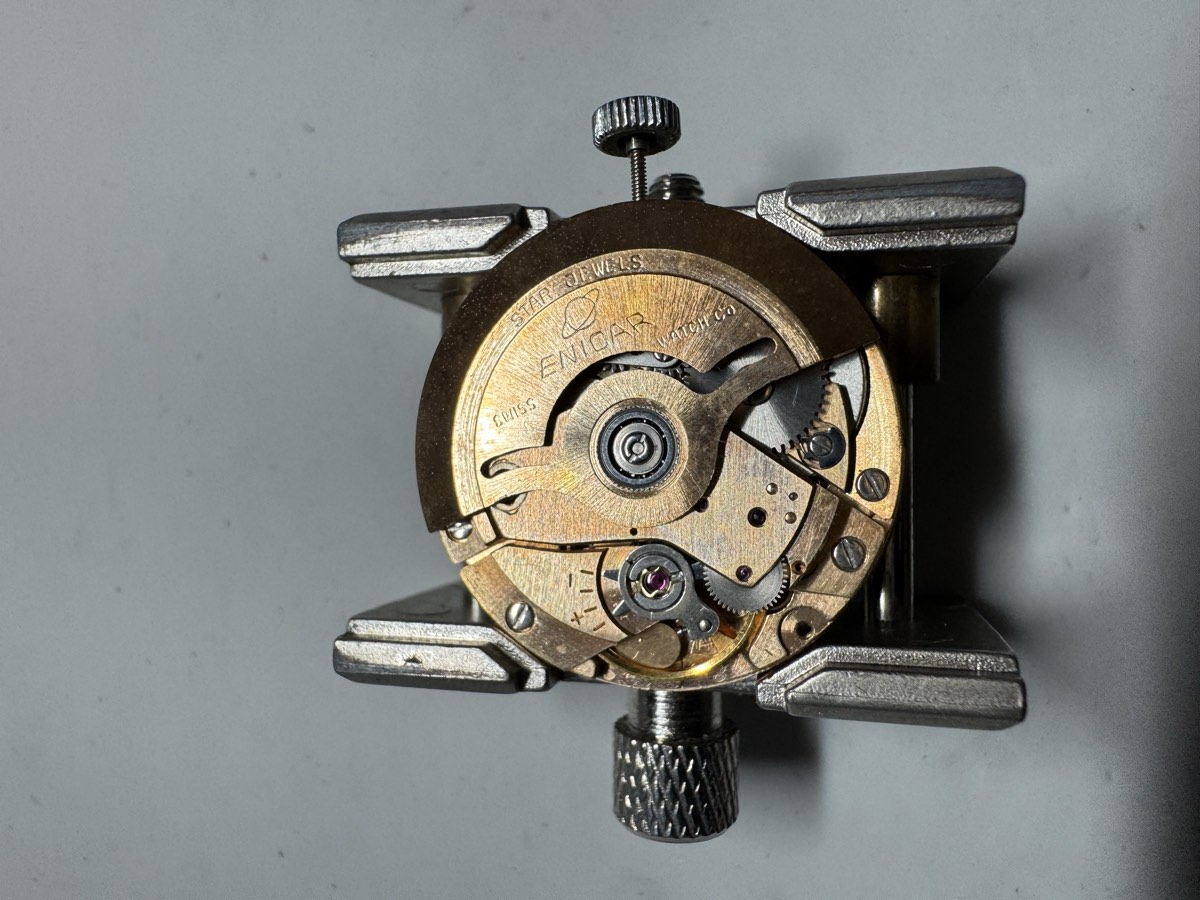
I removed the rotor for further disassembly. You can see the automatic module.
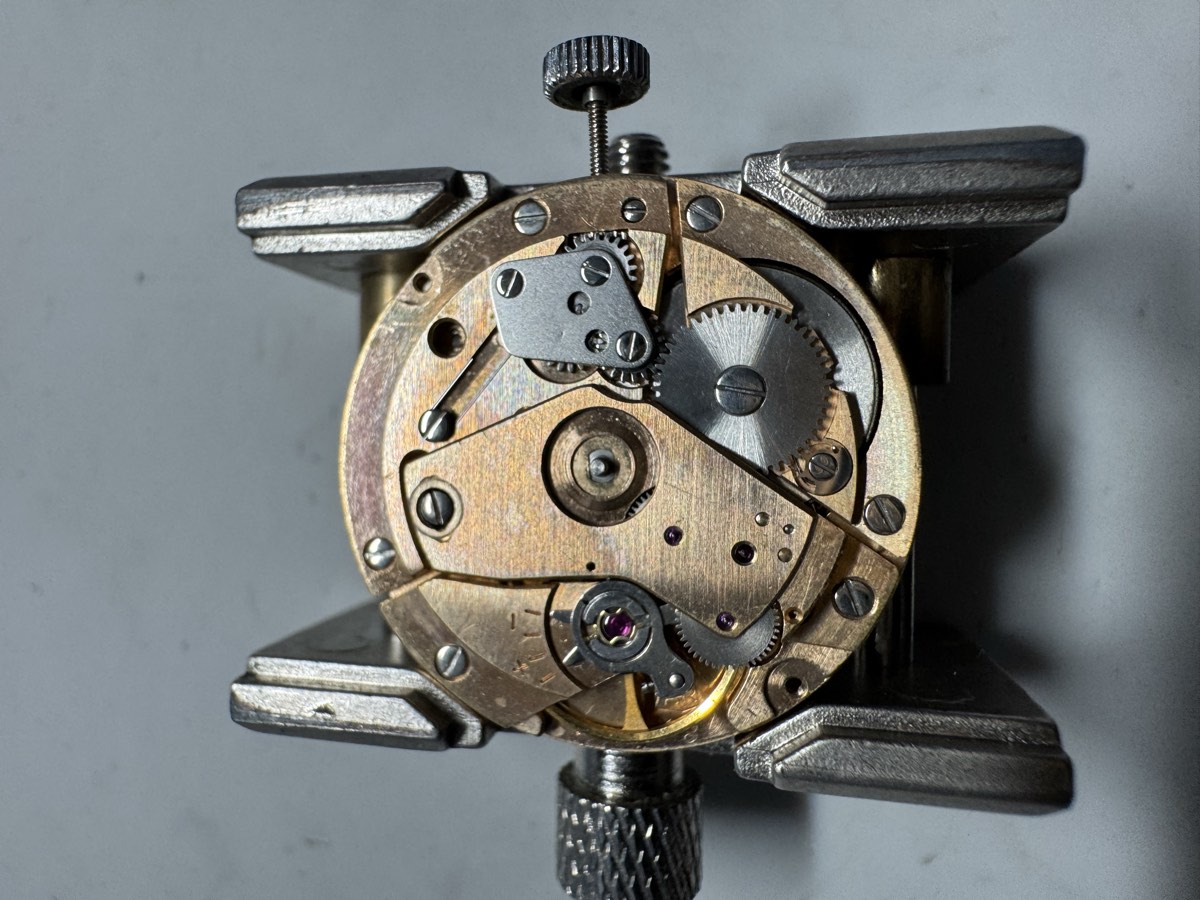
Removing some screws...
2. Automatic works and balance
Without the automatic module, the full balance, gear train and winding mechanism are present.
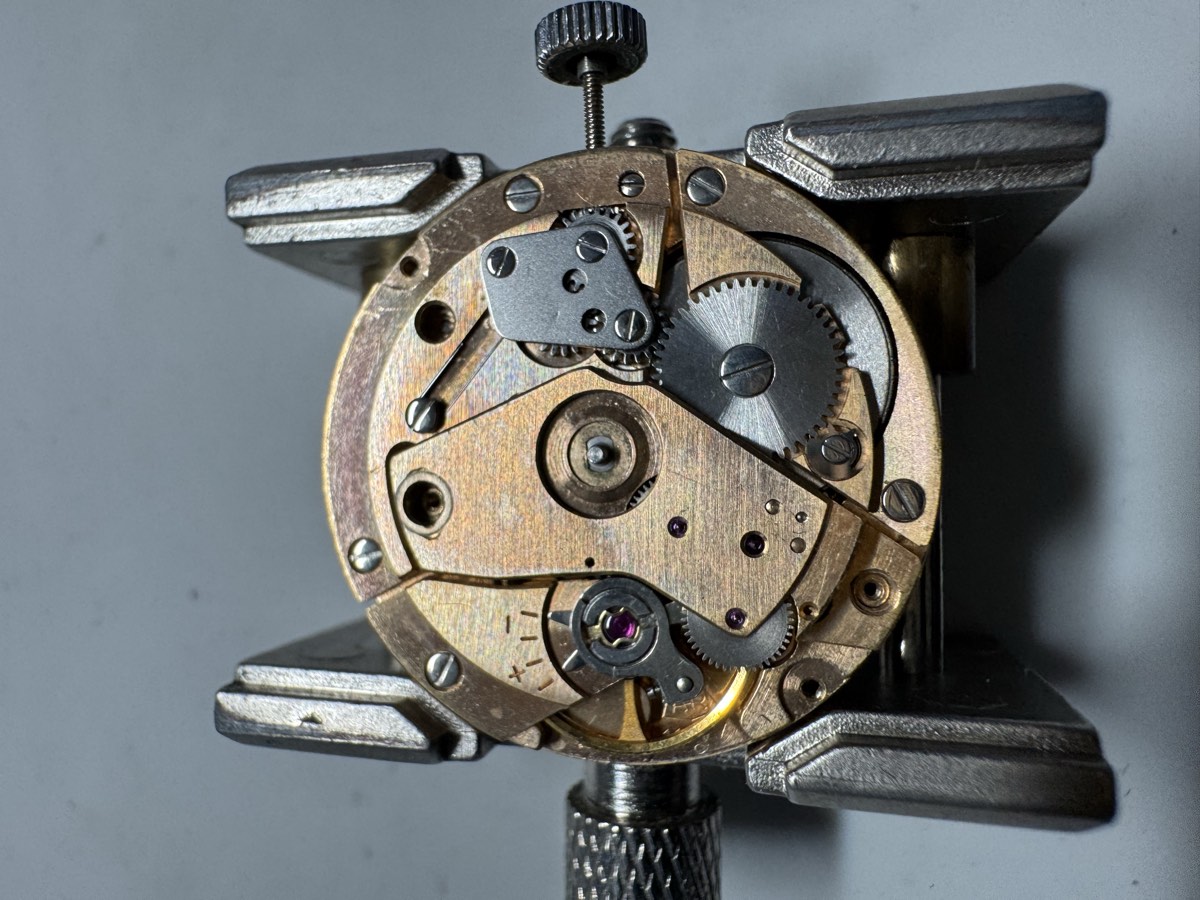
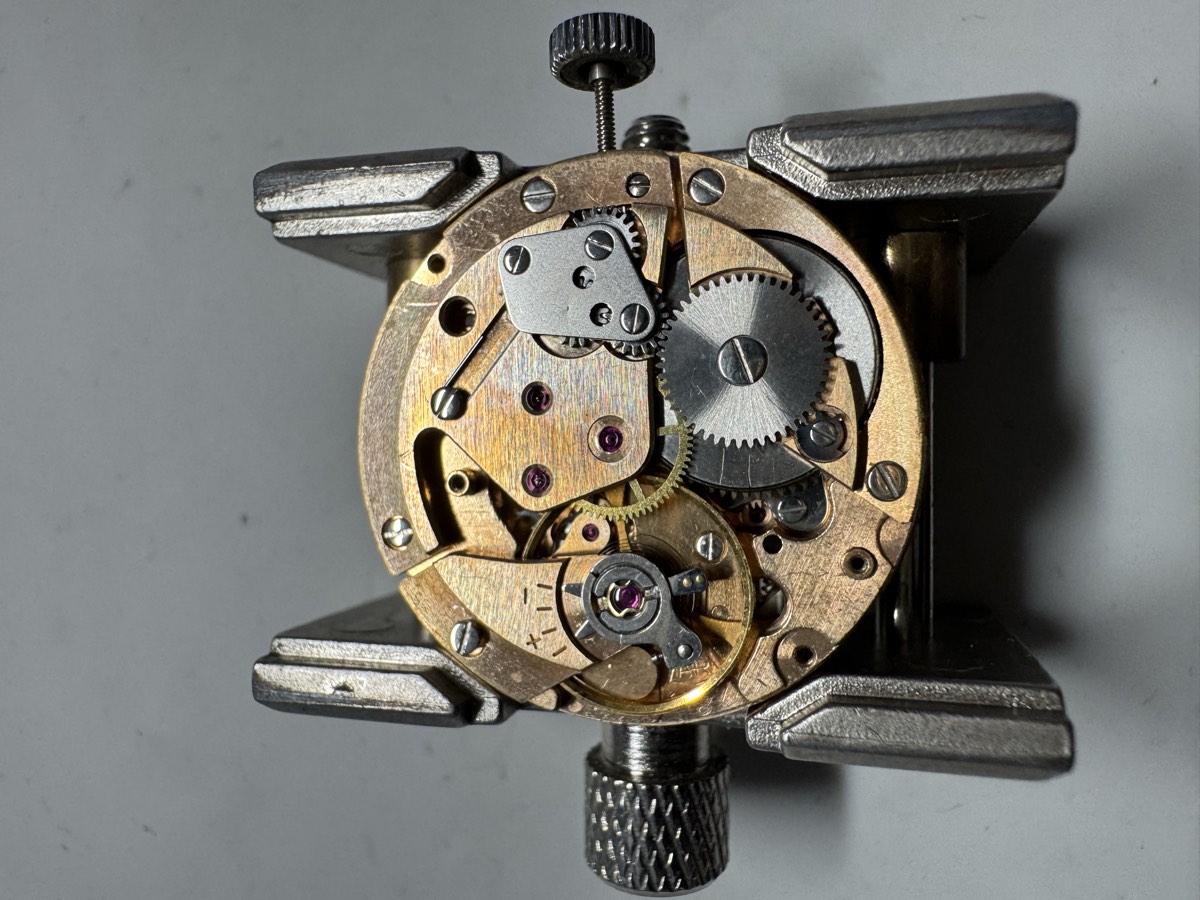
Balance off. You can see the engraving of this rather slept on movement, Enicar's AR 1147.
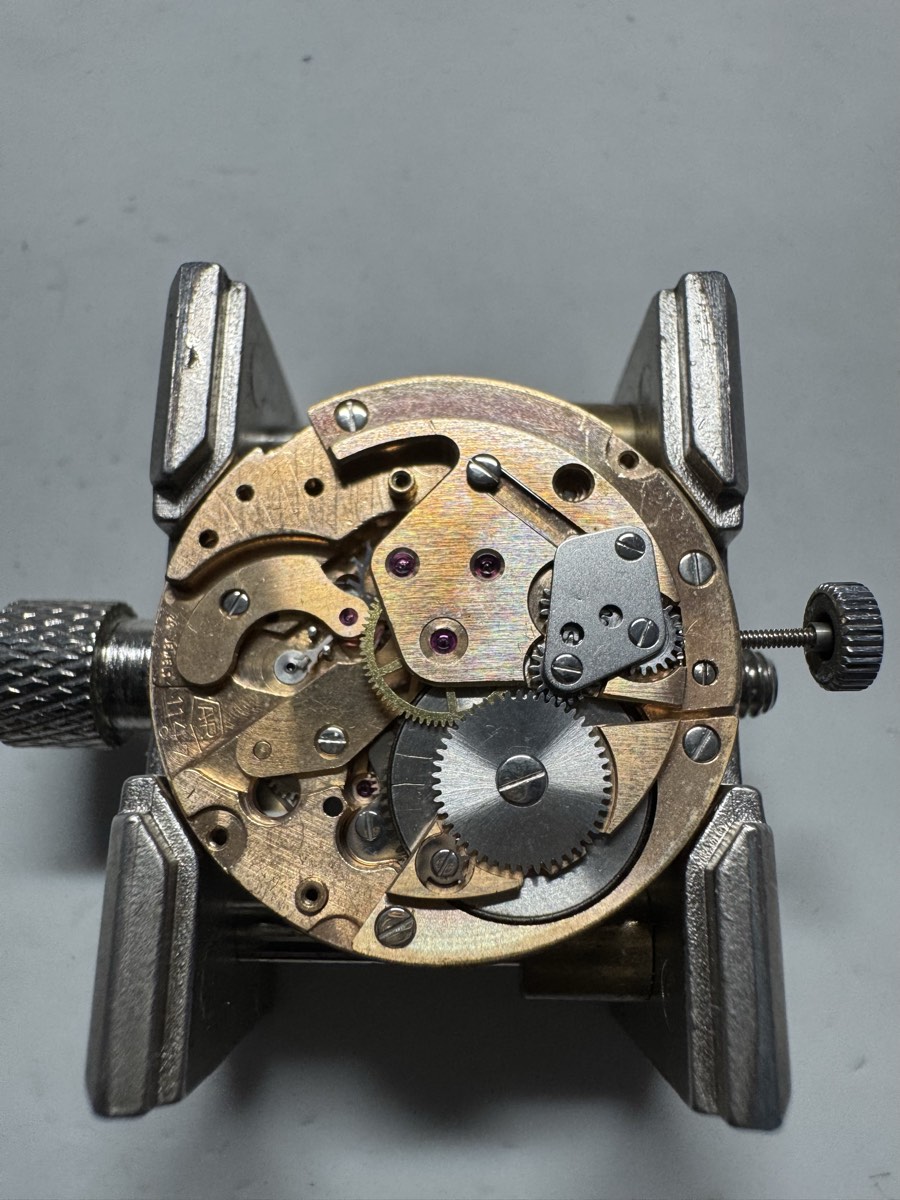
The winding mechanism gears are present.
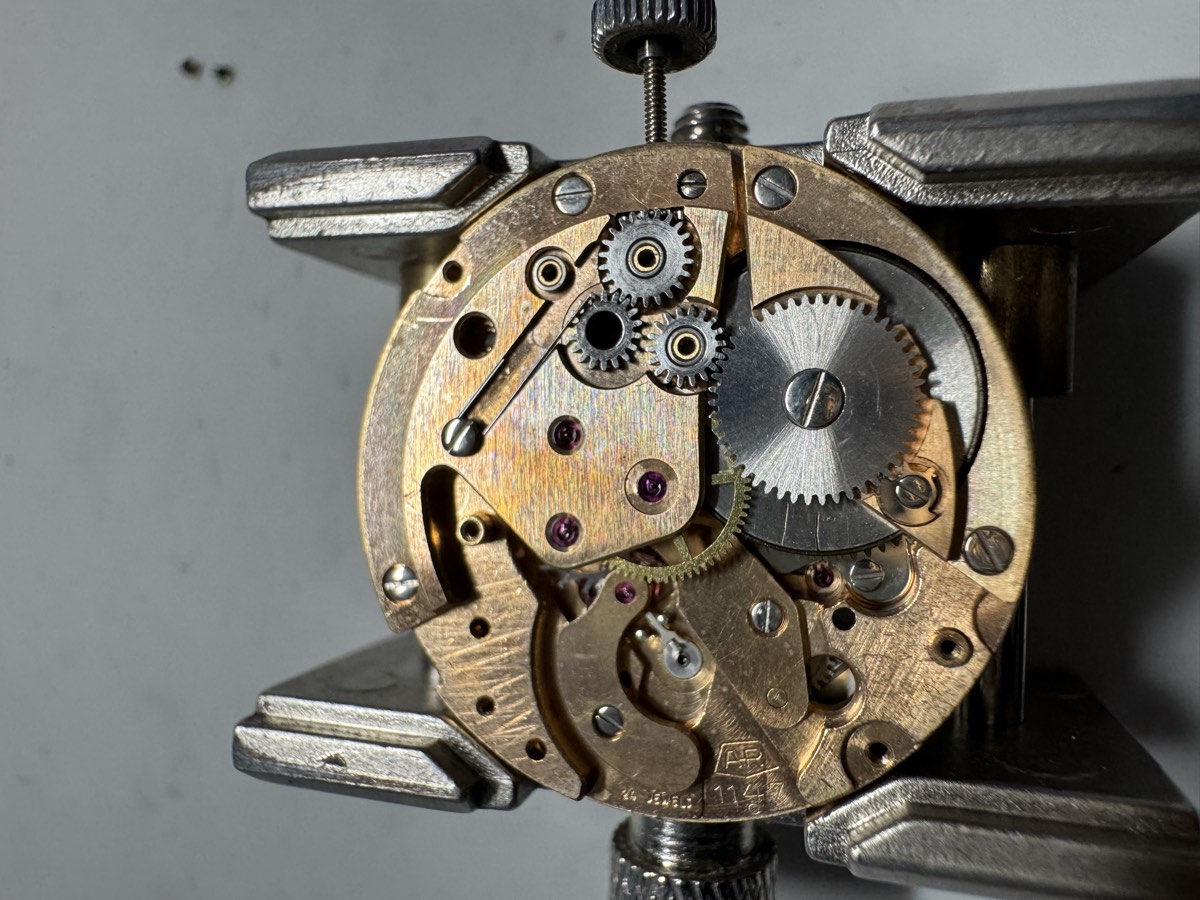
Always be careful with springs... they tend to fly out!
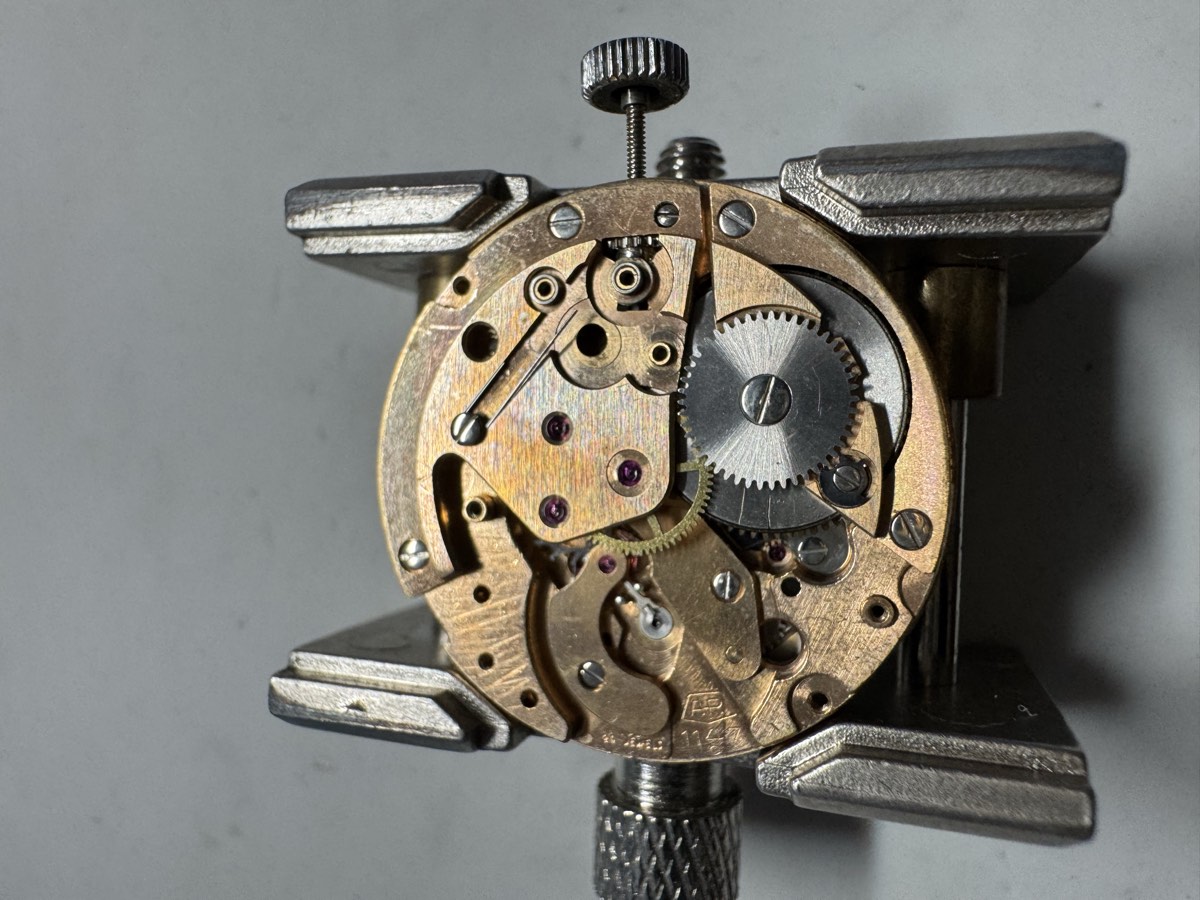
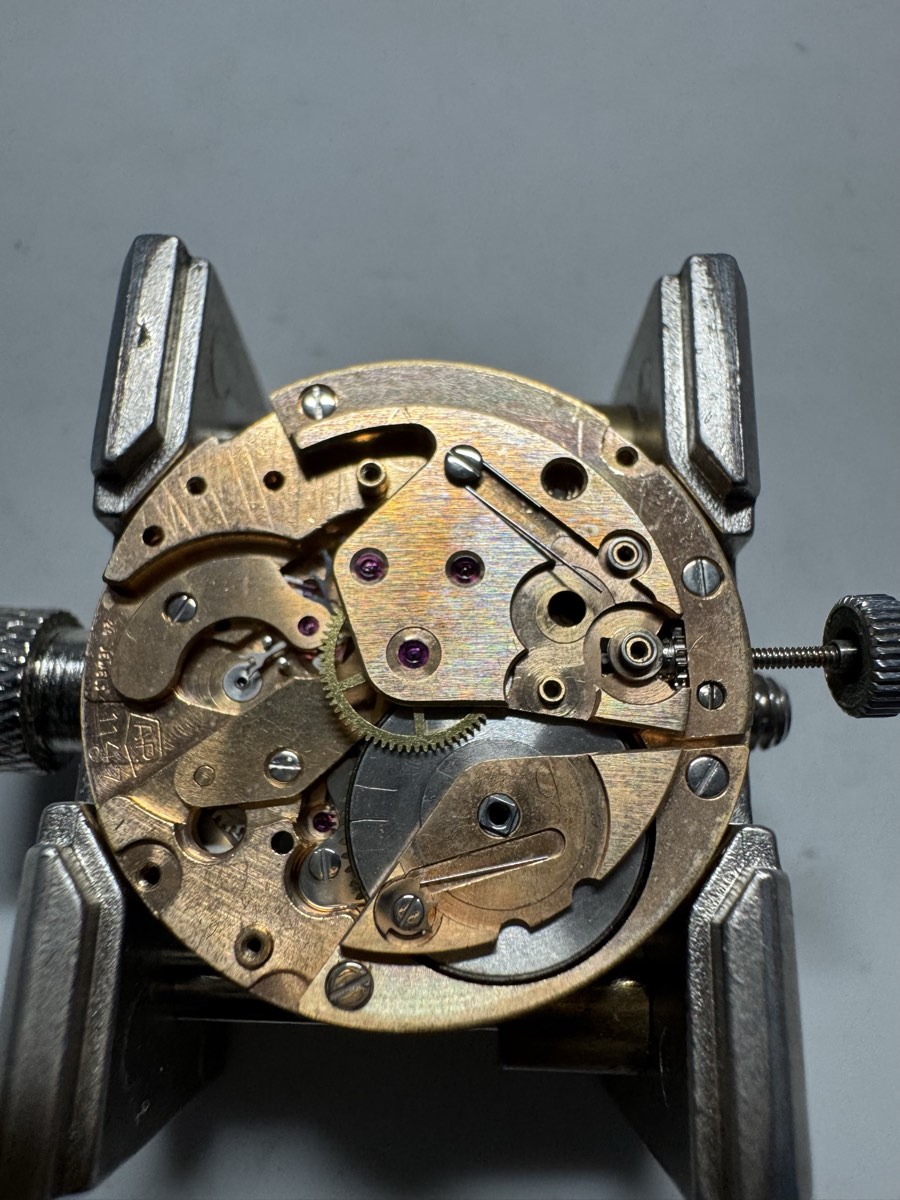
3. Barrel and going train
Pallet fork removed, carefully, so as not to damage the pivot and jewel.
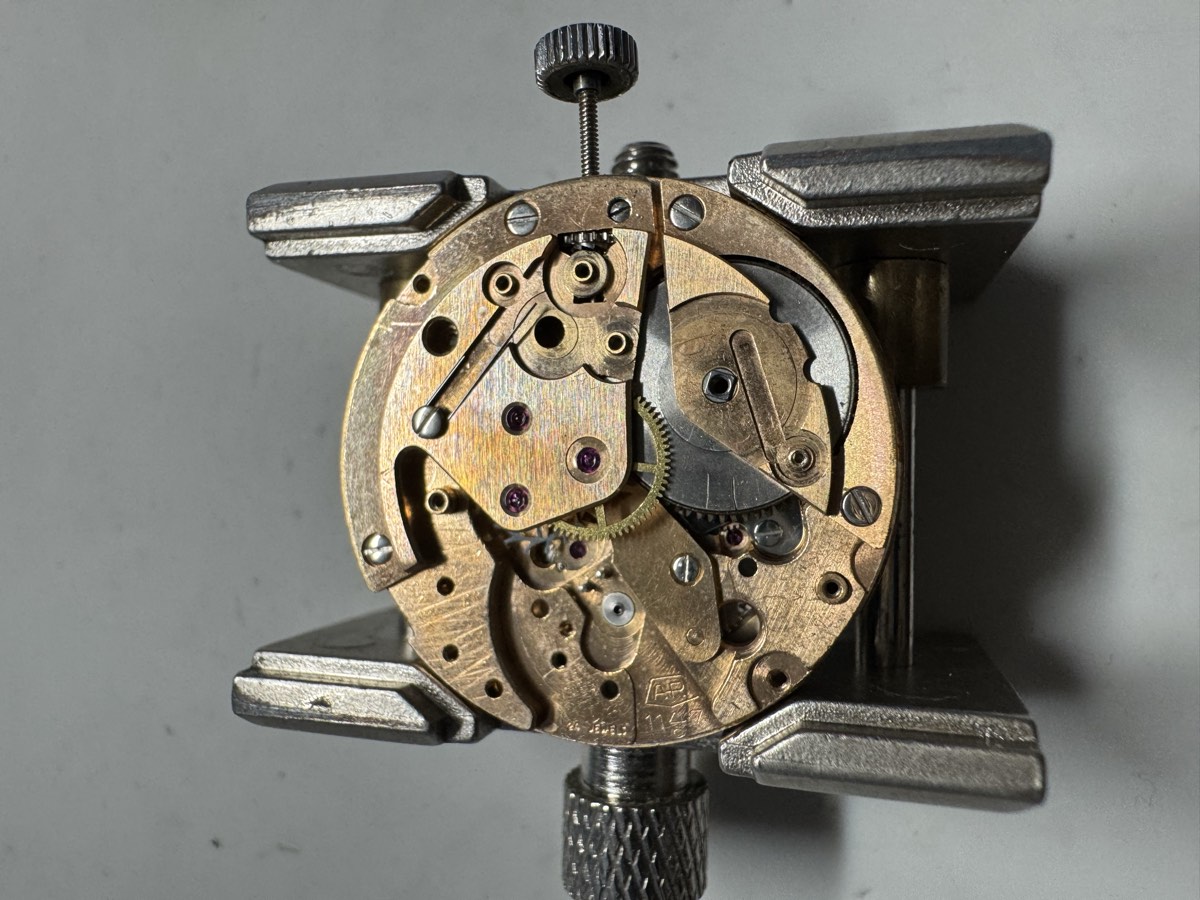
Gear train seems to be intact, no missing tooth.
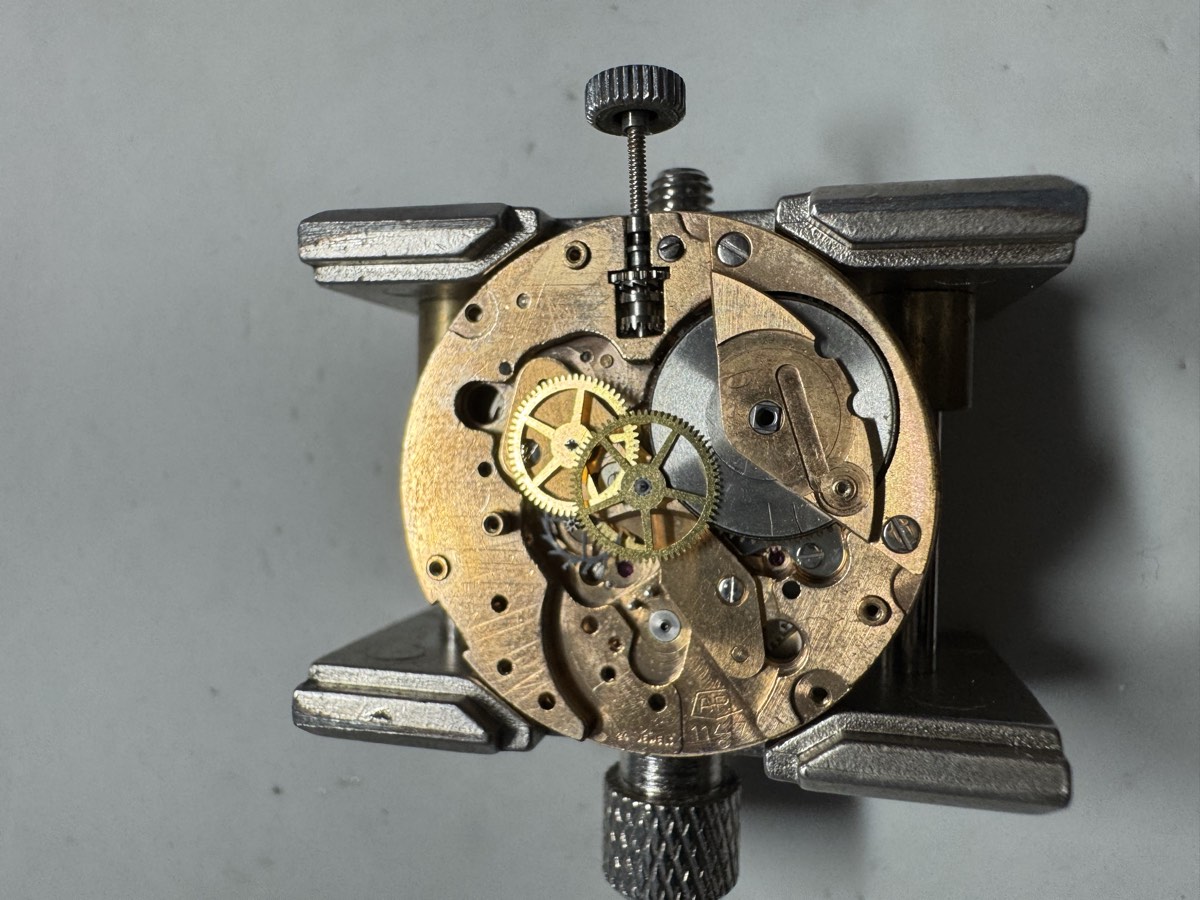
Moving further...
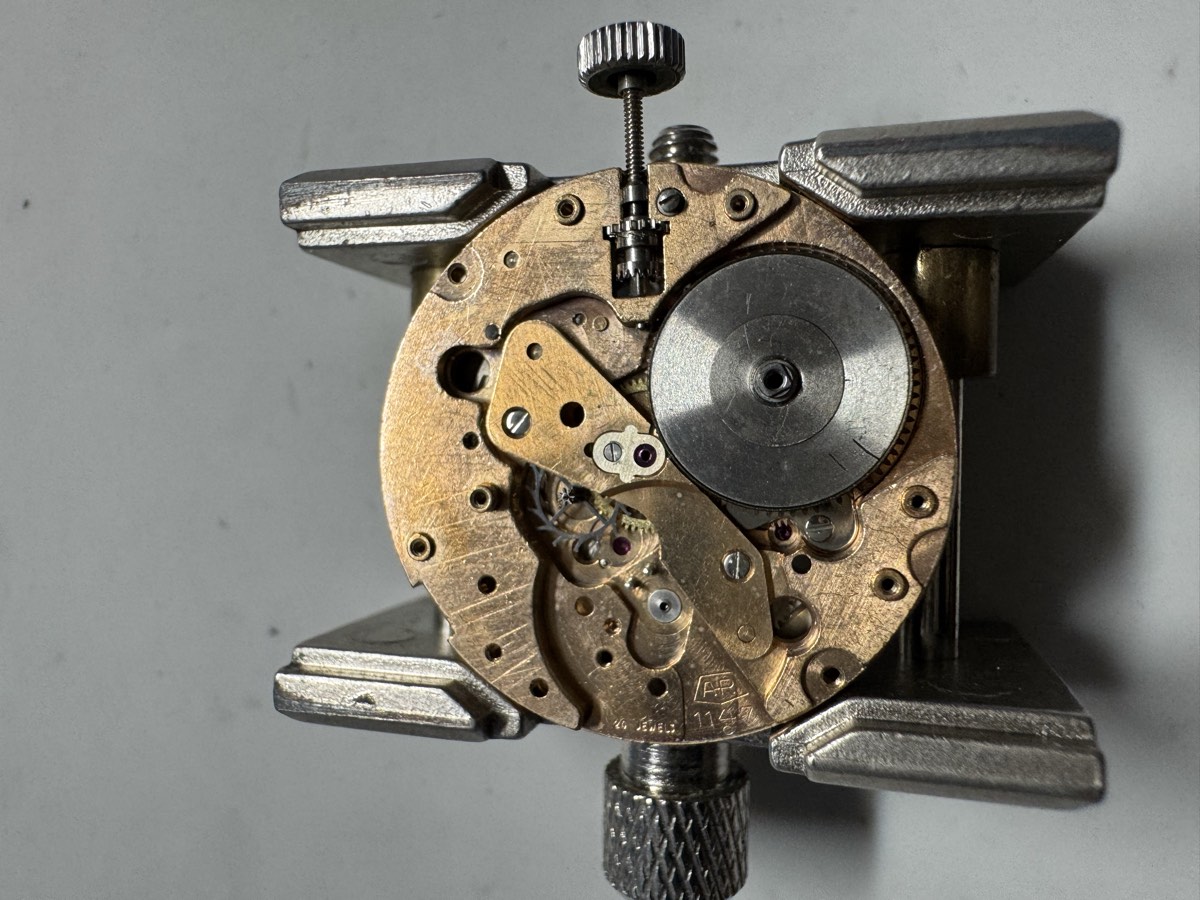
The center wheel and escape wheel are present. Almost done with this side!
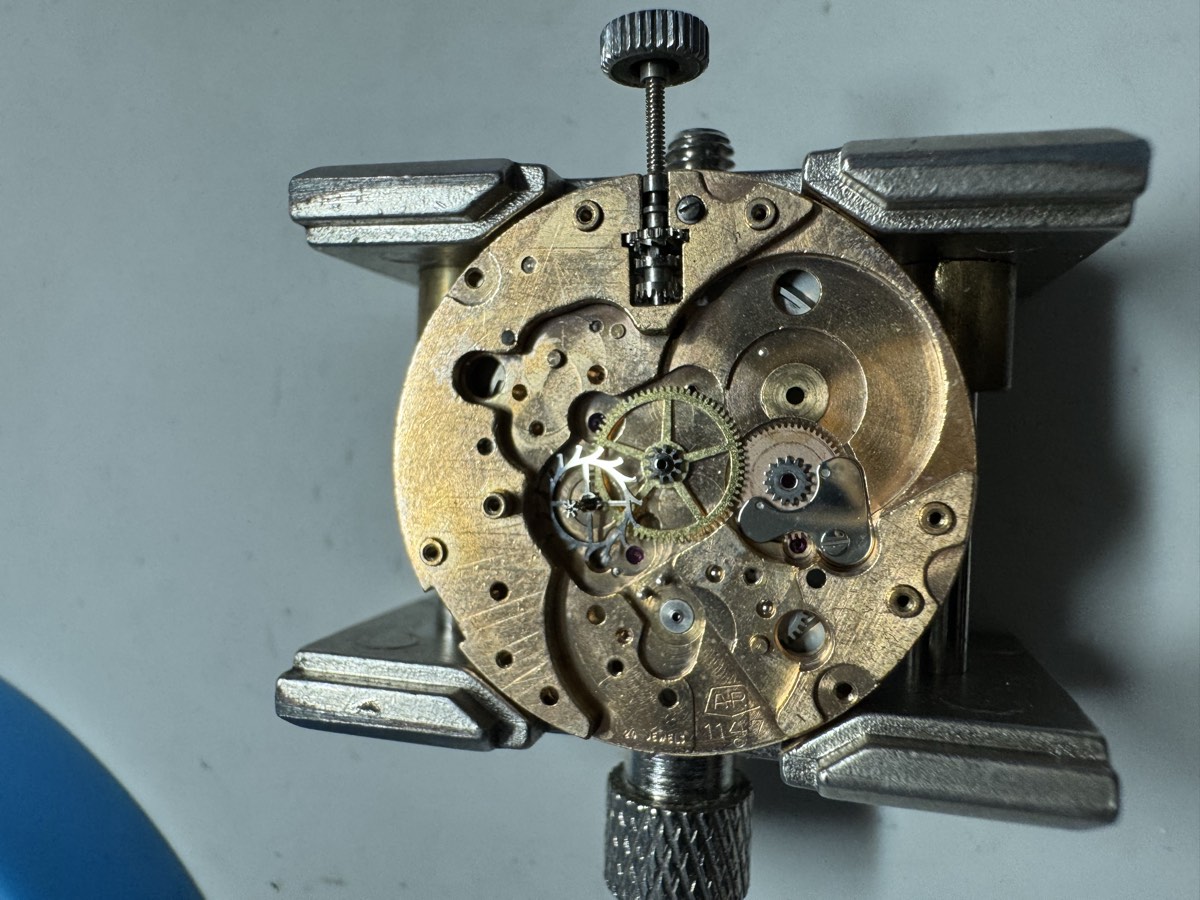
4. Dial side: date ring and keyless works
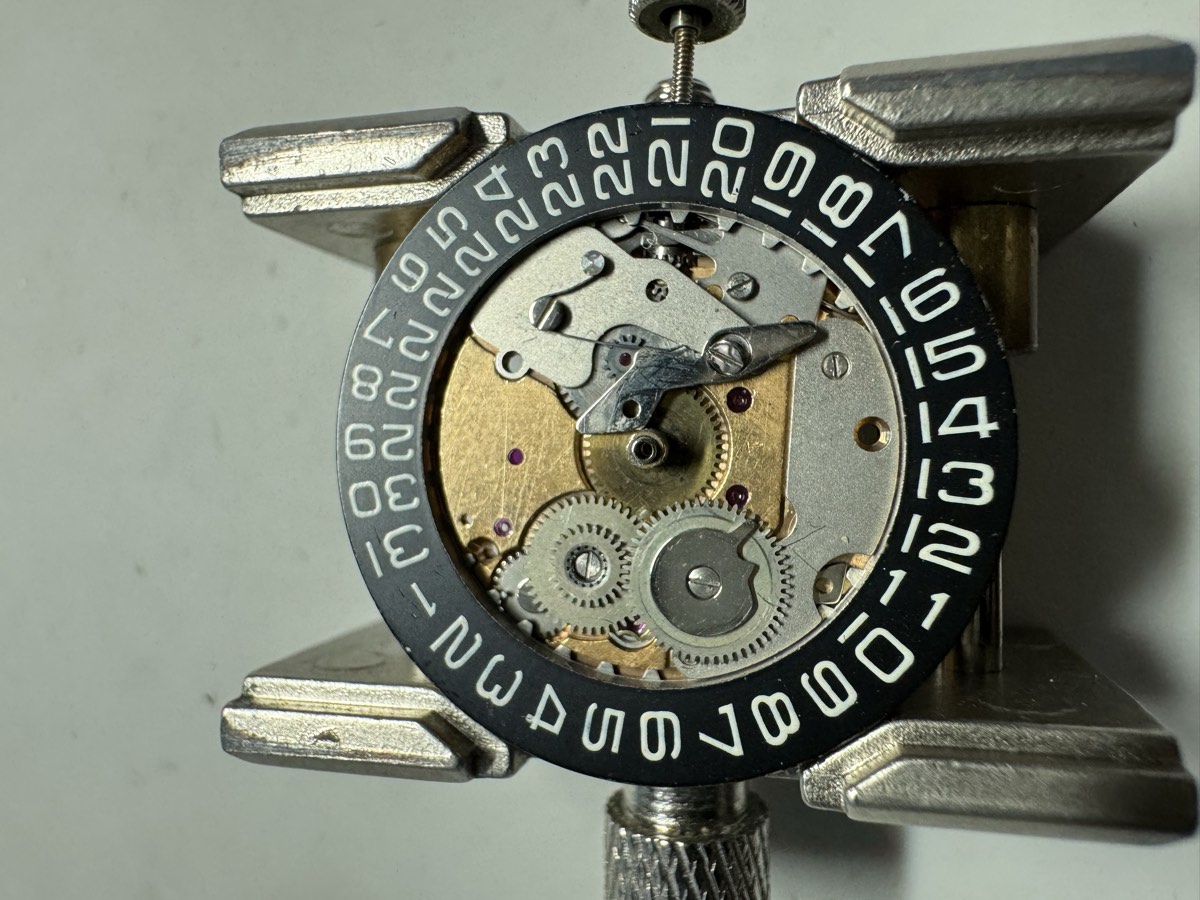
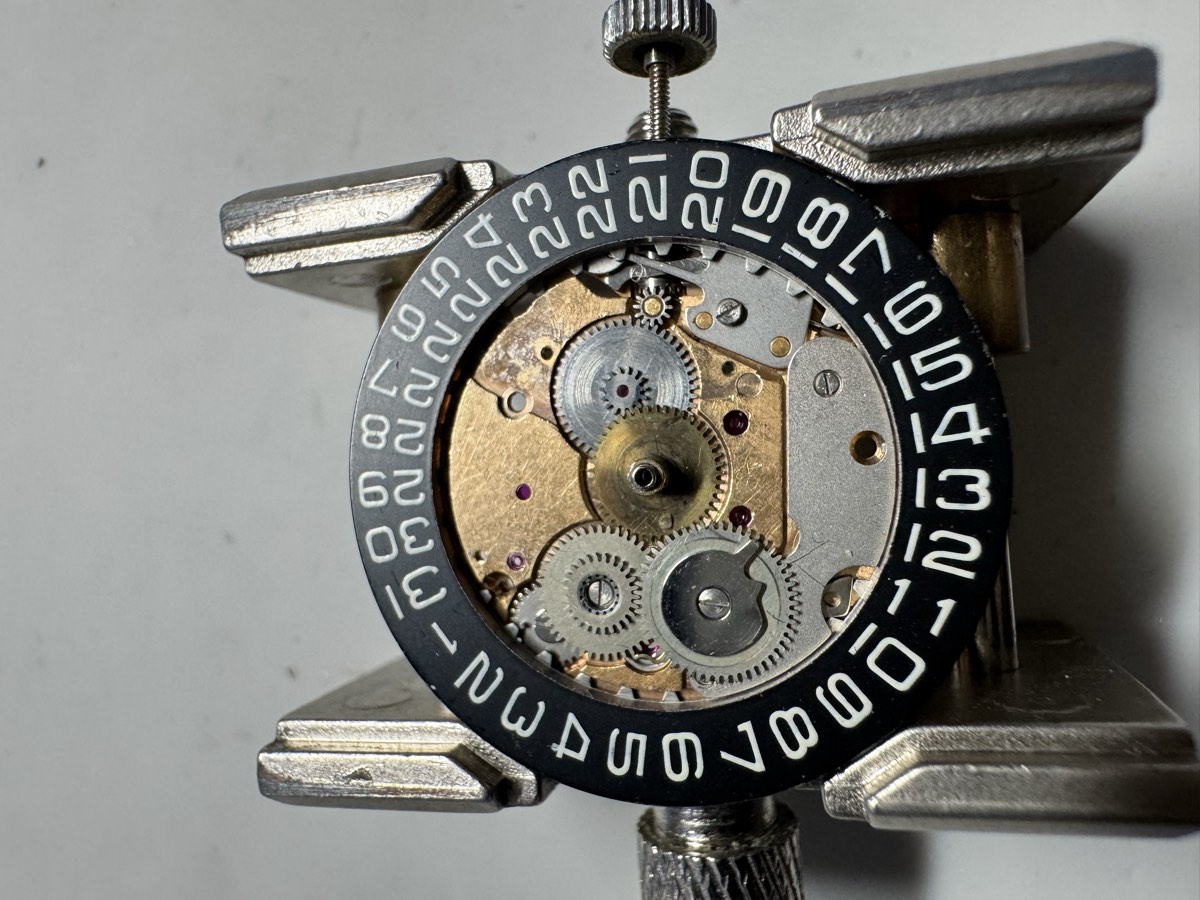
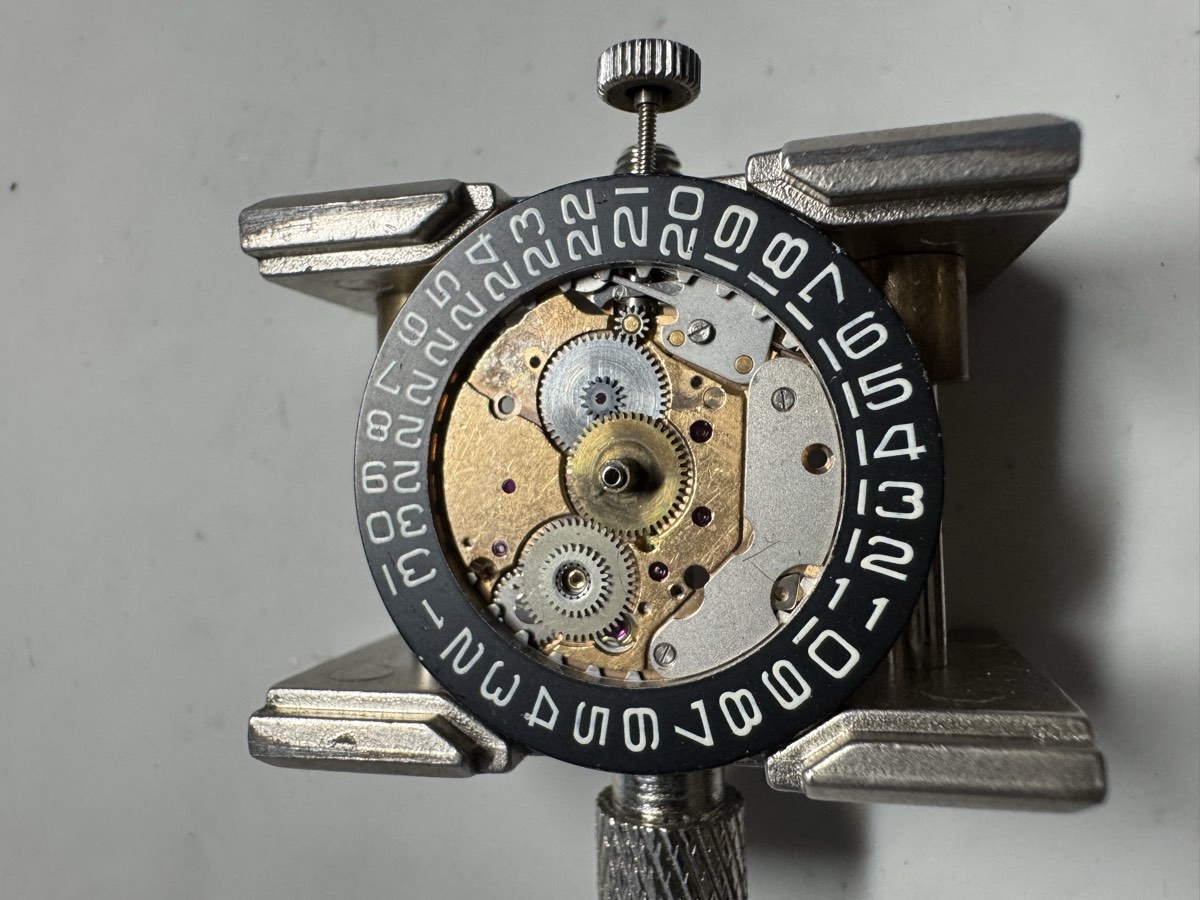
The minute wheel stud seems to be made of ruby. Normally it's steel on watches...
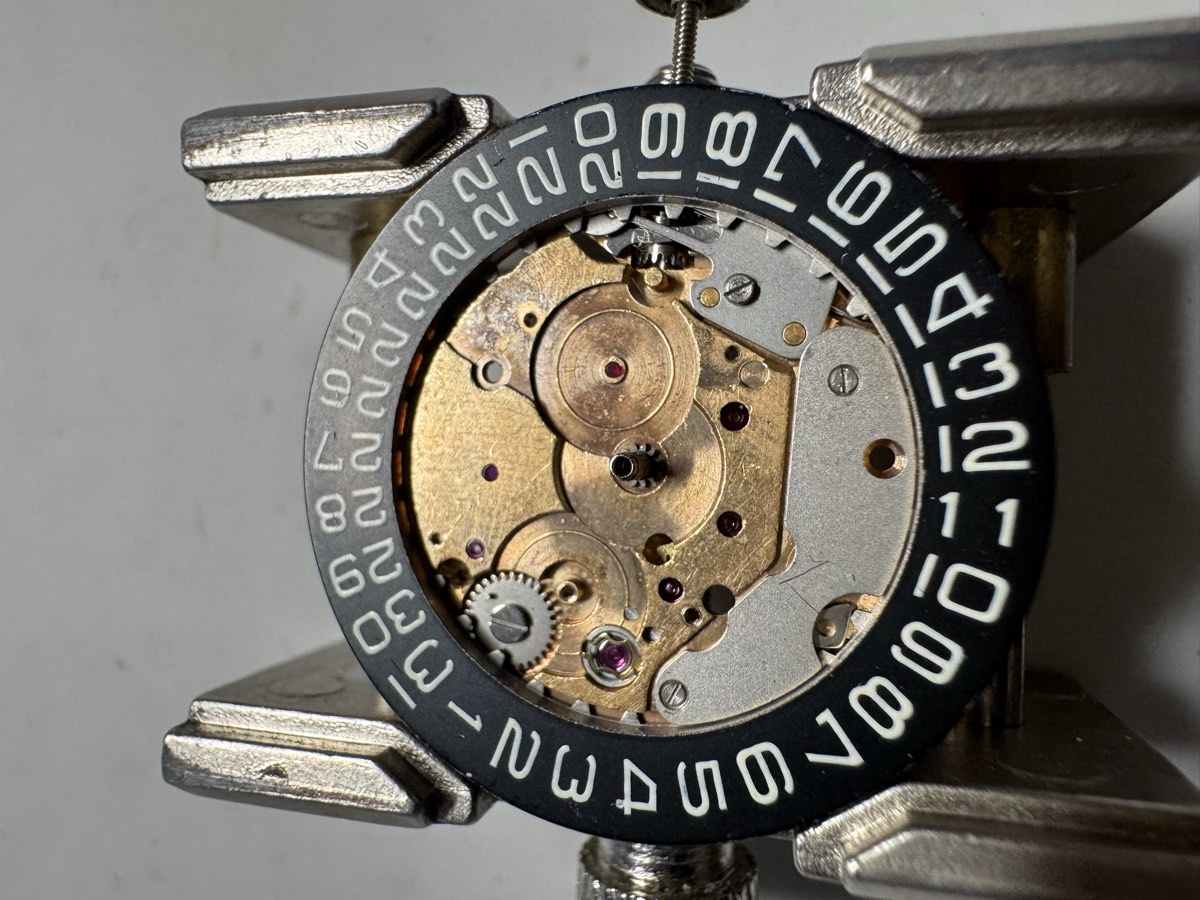
Date wheel removed.
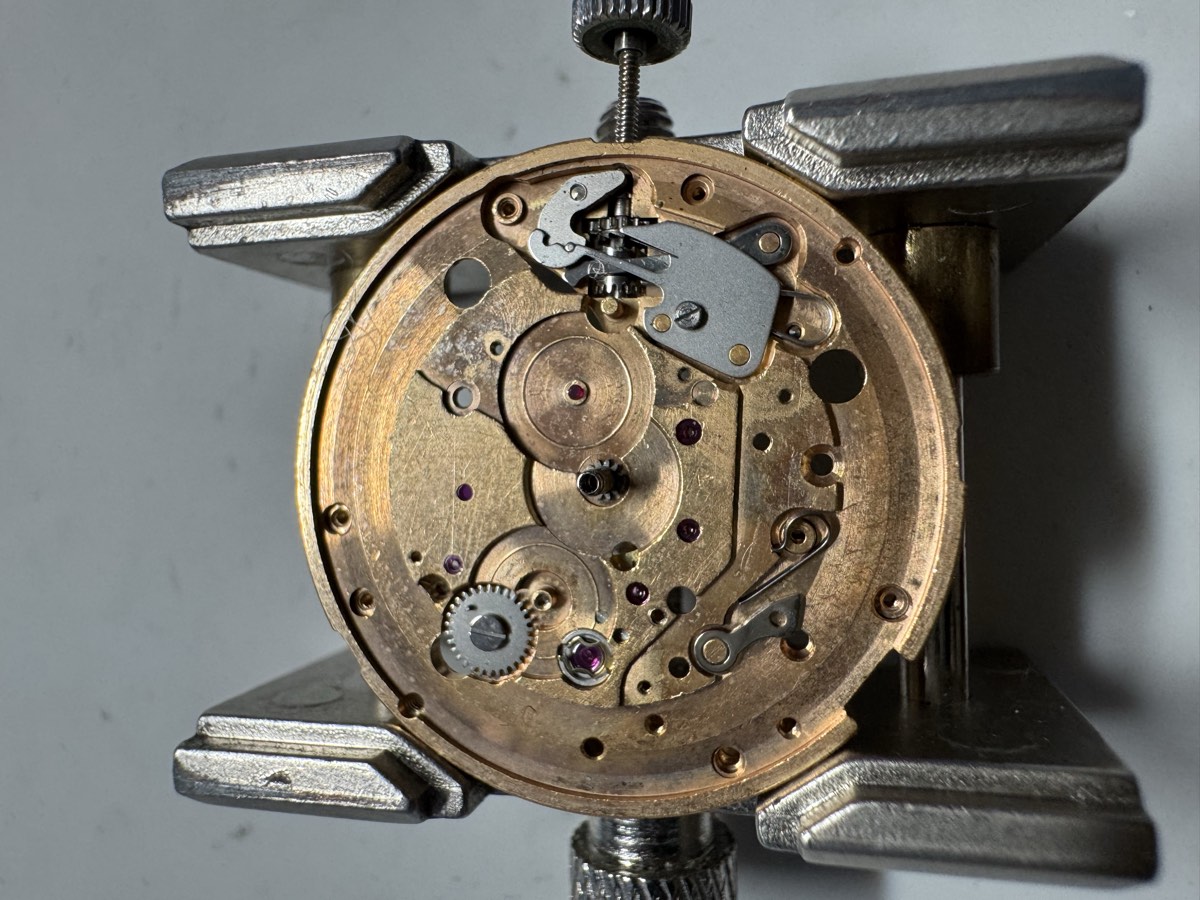
Now to the keyless work and cannon pinion.
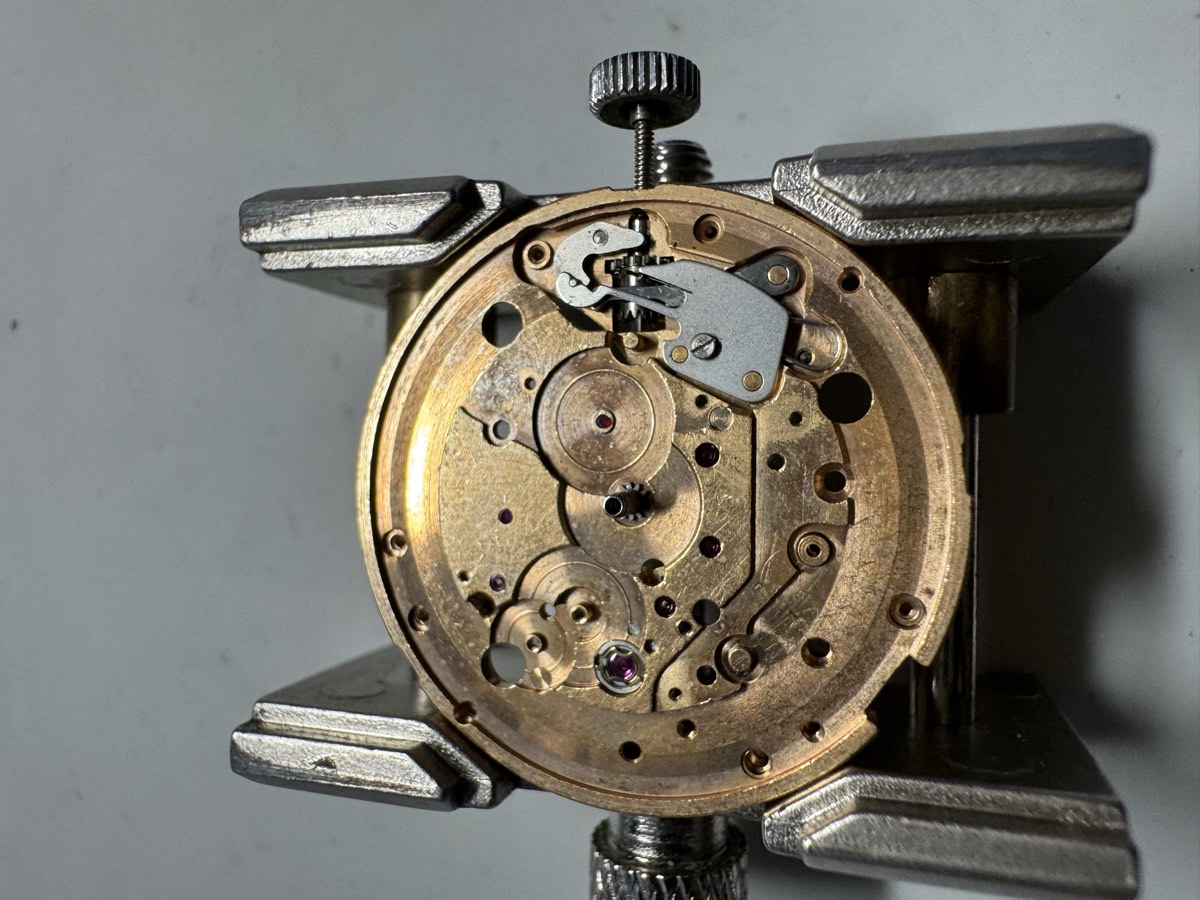
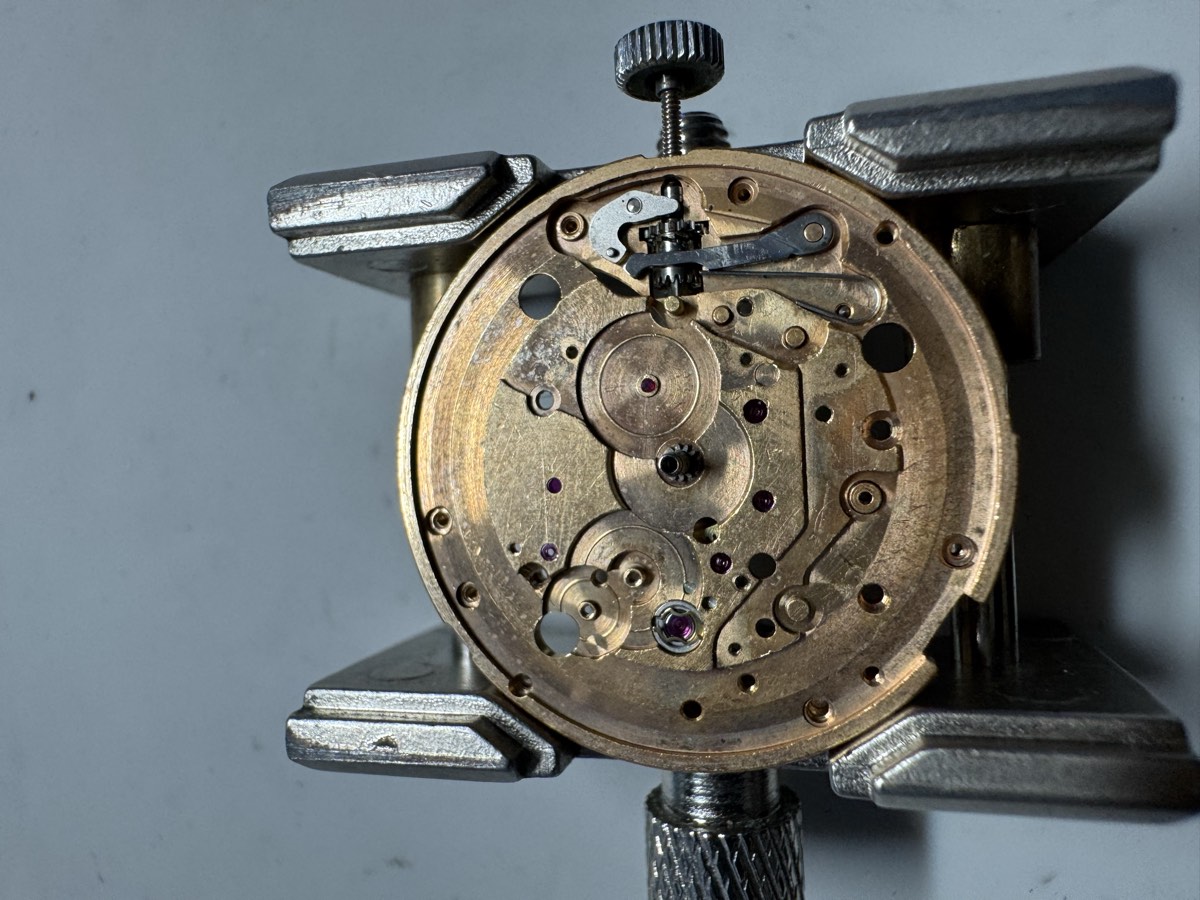
Finally, the keyless work, the yoke, and some final disassembly.
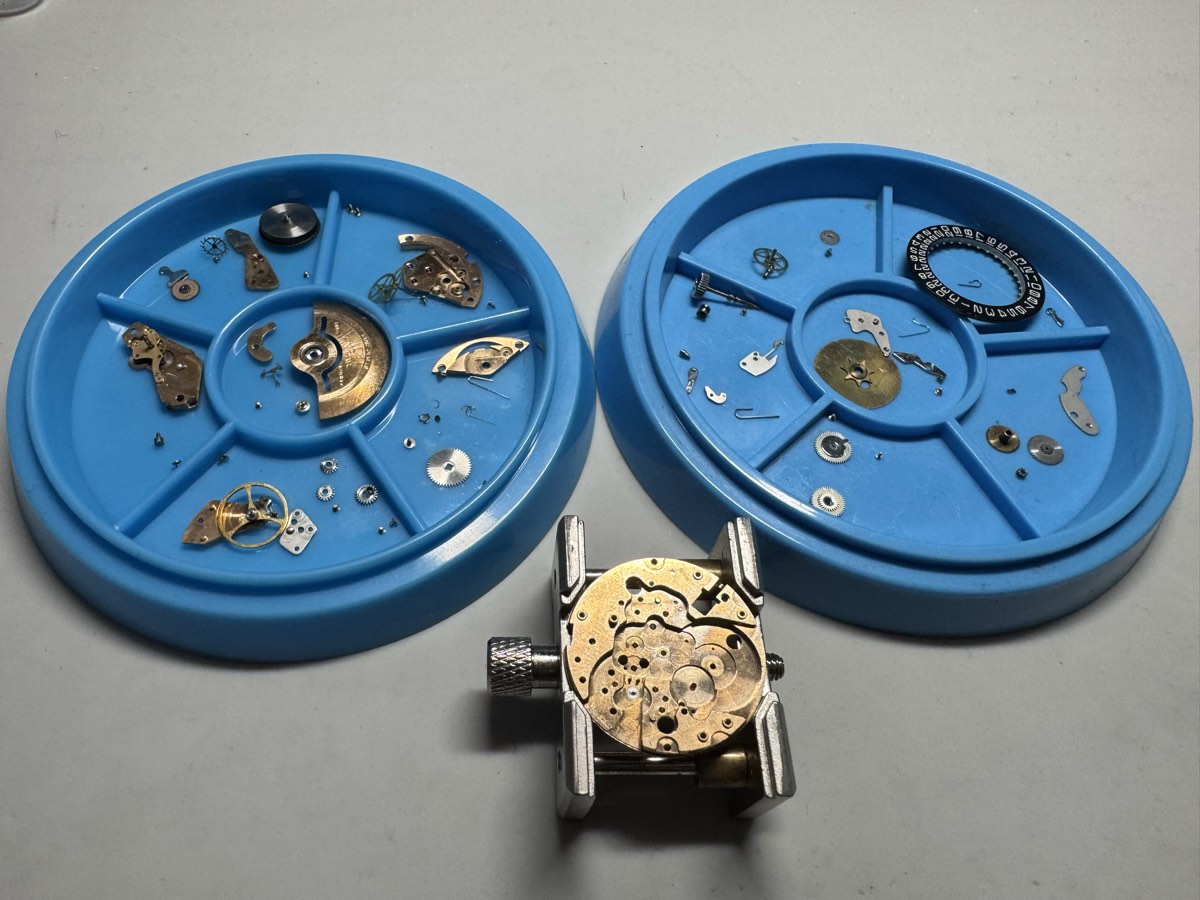
And that is the entire watch, in two trays.
A surprising detail
One thing that surprised me while disassembling this movement: the minute wheel and the automatic transmission wheel both run on ruby studs. On most watches I'd expect steel in those places. As it turns out, these are the extra jewels that bring the AR 1147 up to 24, as described in The movement above.
Reassembly and conclusion
After fully disassembling the watch, I was able to diagnose why it wasn't running. Simply old oil! What great luck! The missing crystal, the missing seconds hand and the loose day disc were separate problems, which I cover below. After cleaning all the components, I was able to assemble it again, and it's running well.
Repairs and parts
The crystal. The first thing I noticed was the missing crystal. I picked up a 31.8 mm replacement, and it wasn't a perfect fit. A 32 mm crystal was too large, so I had to secure the 31.8 mm one with some Seiko S-314 UV adhesive.
The seconds hand. The seconds hand was missing as well. I was able to source a 0.21 mm hand that fits, although it's a little short. For now it does the job, and I plan to replace it later once I have more parts available.
The day disc. This one explains why the day-date function seemed broken at first: the day disc had simply fallen off. Luckily, it was an easy fix. After some fiddling and adhesive, it now works without any flaw.
Assessment
This watch seems to show a prime example of Enicar and its engineering capabilities! It has a very homey feeling to it.
At first glance it might seem a little bland, or even a bit boring. However, I think its cushion case, together with the center line carrying the logo, day and date, makes this watch a great everyday wearer with great legibility.