

Not being able to resist a beautiful engine, in this case the 23ZS Movement, not being seen, I've decided to create a new casebook that fits perfectly to this under- appreciated timepiece. My main goal was to achieve a case back that faithfully represents the original, yet have a modern touch to it. Of course, I will have a in depth review of this watch in my website when time allows.
Concept and inspiration
The concept of this project was not to show as much movement one could see, but rather to make a window that encases the most well designed proportions of the movement, hiding some of the details that might be seen as unattractive ( the case screws ).
I've got my inspiration from my experience working on vintage King Seikos and Grand Seikos, where often see- through backs are a must-have by the Seiko community to protect the all-precious gold medallion and to look at the beautiful movement. Why not a see through case back for a Longines too? I don't see it done often on vintage Longines pieces and I figured it would be a great opportunity!
Design and development

Now to the design, as I am trying to preserve the original case back design with some modern tweaks, I disassembled the watch, measured the case, and got some key dimensions for it. After some fiddling with the dimensions, I was able to mock up a dish shaped case back that is almost identical to the original, yet with a modern construction.
Normally, most watches have screwed on casebacks. However, as you can see, this vintage piece had a case back held together with a tension screw over the main case back, resembling some bostok compressor cases. This has made it easier to achieve a perfect fit, as there is no need for fabricating an accurate thread that fits the main case.
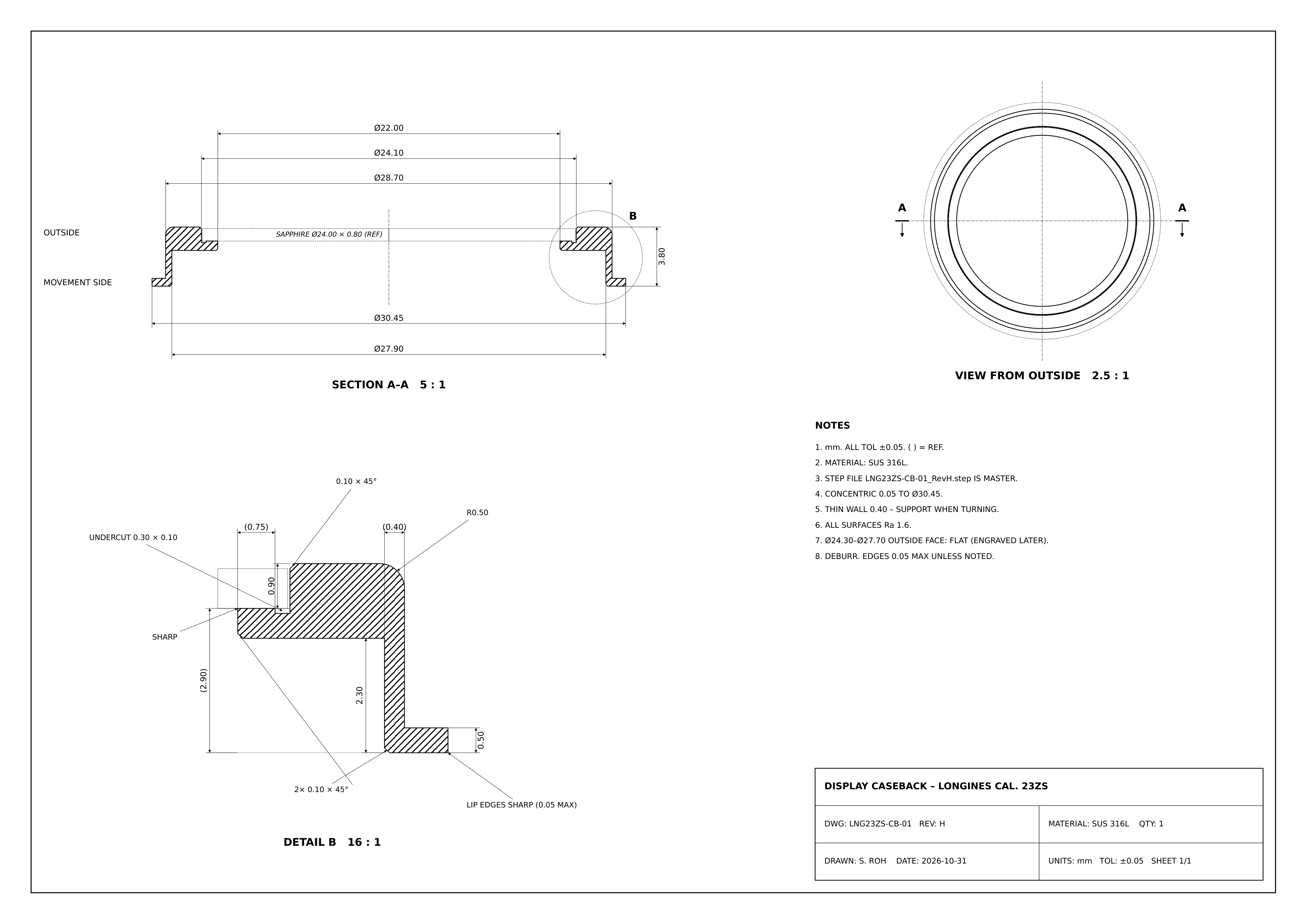
Above is the final blueprint with the key dimensions to fit the case without any tolerance issues. Unfortunately due to the height of the sapphire crystal, the height is a tad bit higher than how the original case back sits. I consider it as a fair tradeoff to the prestige of movement viewing, which I can live with.
In addition,I have decided to fit a 24mm ^ .8mm sapphire crystal to it, glued by Seiko's S- 314 UV adhesive, which is an industry standard.
Technical details
Now, here are some technical details for those who want to make their own case back!
The caseback is CNC-turned from a single piece of 316L stainless steel to fit the original Wadsworth case. A thin lip at its base sits in the case bore and is clamped by the stock retaining ring, just like the original solid back. A flat sapphire crystal is glued into a stepped seat and sits slightly below the surface, which keeps its edge protected. A small undercut at the corner lets it sit perfectly flat. Underneath, a deep relief clears the movement, so the watch is no thicker than before. The outer face has a soft R0.5 edge and a flat ring reserved for engraving.
- Material: 316L stainless steel
- Crystal: flat sapphire, Ø24.00 × 0.80 mm, UV-glued
- Diameter: Ø30.45 mm lip / Ø28.70 mm body
- Height: 3.80 mm
- Window: Ø22 mm
- Underside relief: Ø27.90 × 2.30 mm (0.40 mm wall)
- Tolerance: ±0.05 mm, concentric within 0.05 mm
- Finish: Ra 1.6 µm as machined, hand-finished
Where it stands
The part is being machine turned as of now, and materials are being shipped in as I write this post! Stay tuned not to miss the final product!
As some wise machinist said, measure twice!